Thomas Valter • Director of Product Management, RTW
March 12, 2026
Where Do Dialog Intelligibility Problems Originate?
What are the challenges when creating content with clear and intelligible dialog? In this article, we examine the different stages of the audio production chain that can influence dialog intelligibility.
From a metering perspective, some factors can be measured and flagged, while others remain outside the reach of objective audio measurement.

Capturing
Let us begin at the source: the point where the audio is captured.
Performer
The performer (actor, artist, commentator or speaker) can be a primary source of dialog intelligibility issues. Typical examples include:
Poor articulation
Mumbling
Strong dialects or accents
Whispering
These factors originate from the performance itself and may be difficult to correct later in the production chain.
It is important to note that some of these examples may be the result of creative intent. In certain cases, reduced dialog intelligibility is a deliberate artistic choice.
Technical issues
On the technical side, several factors can negatively affect intelligibility:
Sub-standard microphones or recording equipment
Poor microphone placement
Both can reduce clarity and limit the ability to capture speech accurately.
Location
The recording environment also plays an important role. Whether dialog is captured outdoors or in a studio, the location itself can introduce challenges such as:
Poor room acoustics
Background noise on location
Dialog intelligibility issues at the point of capture can be monitored using a dialog intelligibility meter operating in real time during the recording process.
Post-Production
During post-production, intelligibility problems may either be improved or unintentionally made worse.
Voice-over-voice masking (multiple voices competing for clarity)
Excessive compression reducing the natural dynamics of speech
Extensive use of effects that can mask the dialog, such as reverb
Poor balance between dialog, music, and effects
Distribution
The path from post-production to the end listener can also introduce intelligibility issues.
Data compression
Encoding and decoding processes
Changes in channel layouts or downmixing
Each of these processes may alter the spectral balance or dynamics of speech, potentially affecting intelligibility.
Reproduction
Once the audio reaches the listener’s environment, additional challenges may arise.
Many flat-screen televisions, for example, use very small speakers that lack the physical dimensions required for accurate sound reproduction.
Factors include:
Poor reproduction equipment
Poor room acoustics
Background noise in the listening environment
The Listener
Finally, the characteristics of the listener themselves can influence how speech is perceived. Several factors come into play:
Hearing impairment
Hearing damages
Listener attention and focus
Age
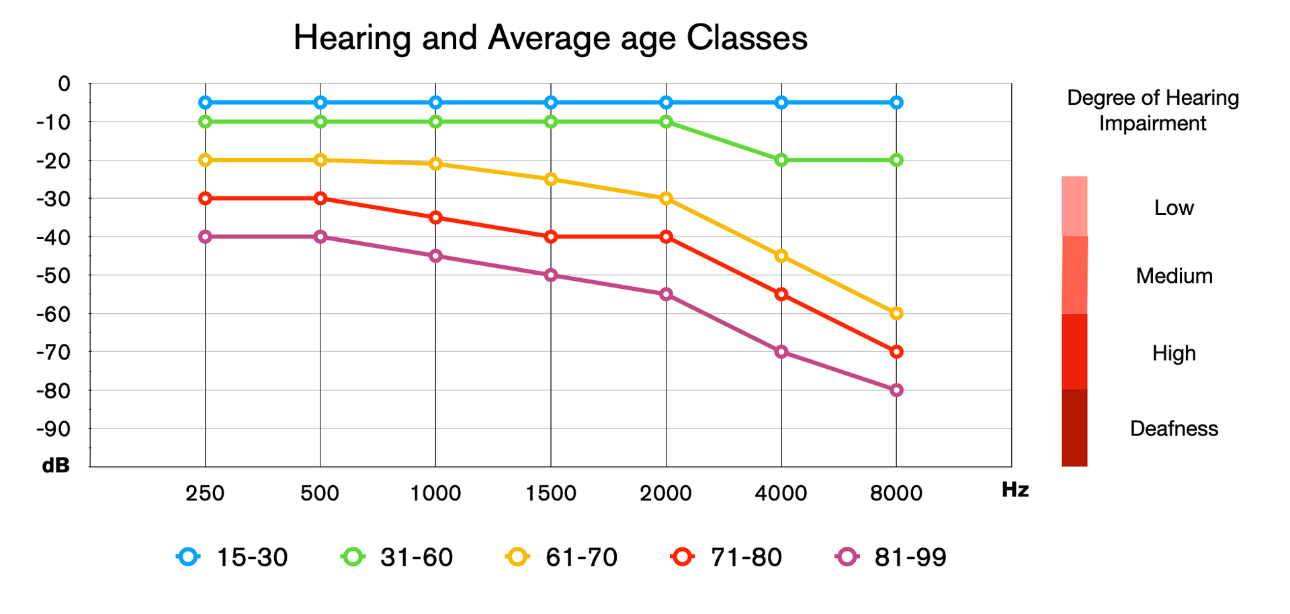
The diagram below illustrates how hearing sensitivity changes with age. While individuals between roughly 15 and 30 years of age typically experience minimal limitations, the impact becomes increasingly significant at older ages.
Where does metering come into play?
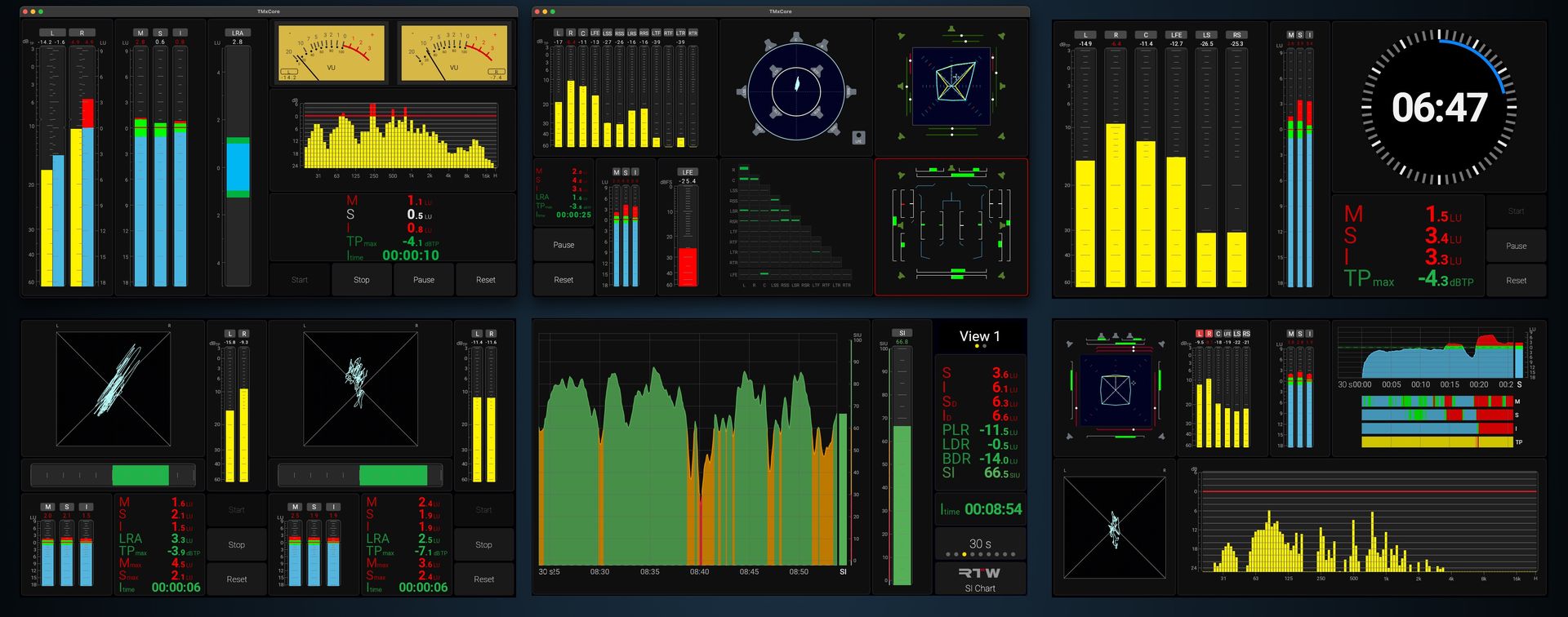
While a meter cannot be applied at every stage, there are several points in the production chain where measurement is both possible and useful for detecting and flagging poor dialog intelligibility as well as other issues.
RTW offers a broad range of metering devices that can be used at all stages of production.
Capturing
It makes sense to detect potential issues as early as possible in the audio production chain. The point of capture is therefore a natural place to begin monitoring dialog intelligibility.
If intelligibility is found to be too poor, a re-take should be considered before moving further down the production chain.
Post-production
Post-production is another natural stage for dialog intelligibility metering. While balancing dialog, music, and background elements, it is important to keep an eye on the ratio between dialog and background content.
Use the Dialog Intelligibility Chart to identify and track sections where intelligibility may be compromised.
Distribution
During the distribution or transmission stage, dialog intelligibility should continue to be monitored to ensure that processing, encoding, or format conversions do not negatively affect speech clarity.
The RTW TMxCore is designed for broadcast environments, offering features such as AoIP redundancy, a separate control port, and other transmission-ready capabilities. It also provides a range of dialog intelligibility measurement instruments to help monitor speech clarity throughout the distribution chain.