Author: Pavel Smokotnin, RTW R&D
The ATSC 3.0 standard¹⁾, released on July 17, 2025, defines a comprehensive set of requirements for terrestrial next-generation TV broadcasting. Let’s dive into its audio part (A/342), see what’s changed, and build a measurement preset for TMxCore tailored to a Next Generation Audio (NGA) broadcasting environment.
A/342 Part 1 defines the common audio elements, while Parts 2 and 3 specify the two supported audio systems (codecs): AC-4 and MPEG-H. For programs transmitted in multiple languages and/or with optional content such as additional commentary, the standard allows the transmitted audio to be organized either conventionally or using a presentation-based²⁾ approach.
The Conventional Approach
The Conventional approach is the classic organization of audio streams, where each group contains a final mix in a defined reproduction layout.
For a program broadcast in 5.1 format with two languages, the measurement setup would consist of two identical dialog-gated loudness meters that comply with ATSC A/85³⁾ recommended practices.
We have created an example preset for TMxCore based on the conventional approach, download it here:
This is how it works.
Overview
The Overview view provides a general measurement of both the English and German streams, including PPM metering, Dialog Intelligibility, LFE Bleed, and a Surround Sound Analyzer, followed by a numeric instrument for each audio stream (group).
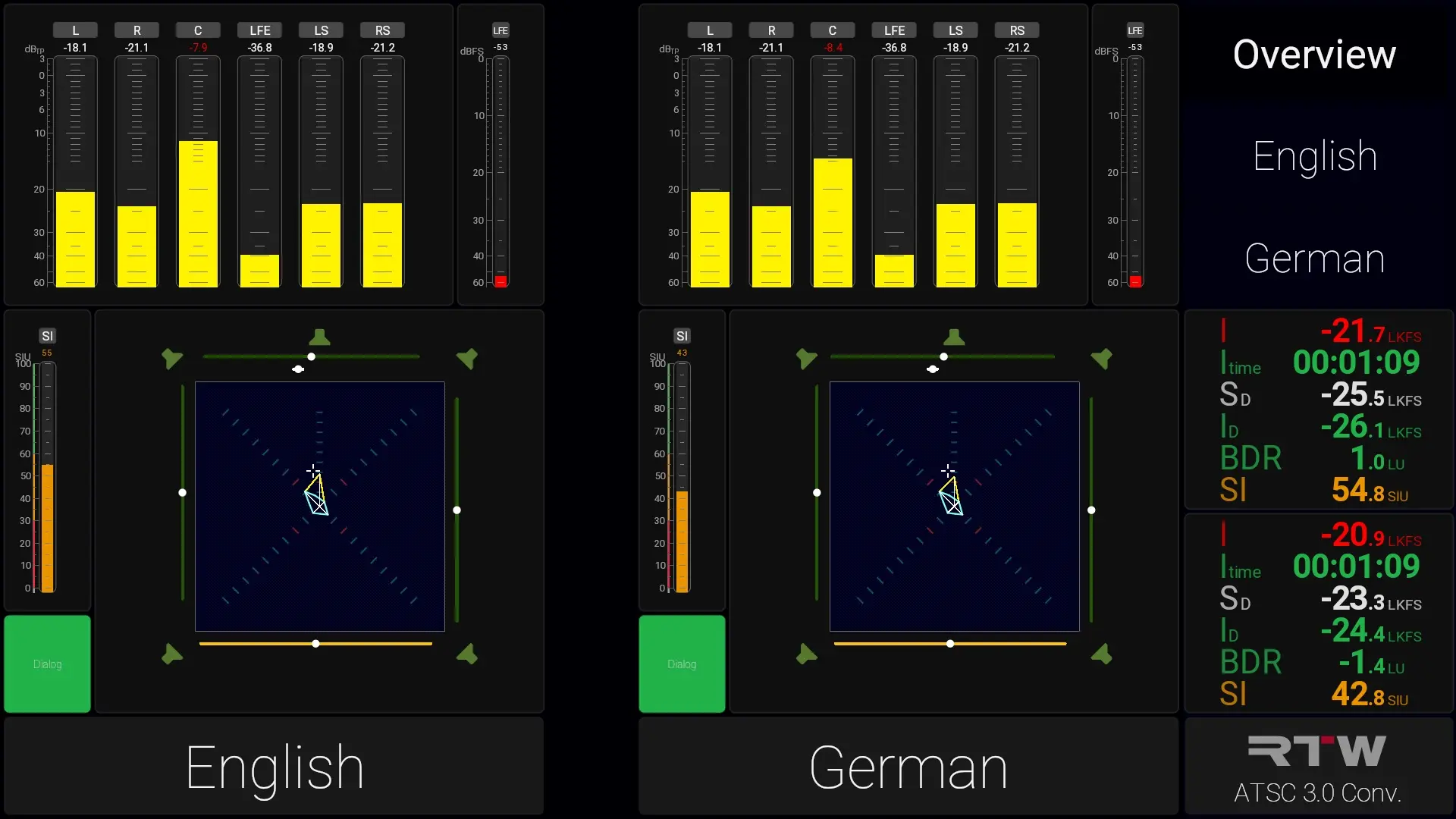
English & German
The English and German views provide a more detailed display for each individual stream, including a PPM meter, Dialog Intelligibility, a dialog short-term Loudness Chart, a Surround Sound Analyzer, a Polarscope, and an LFE Correlator.
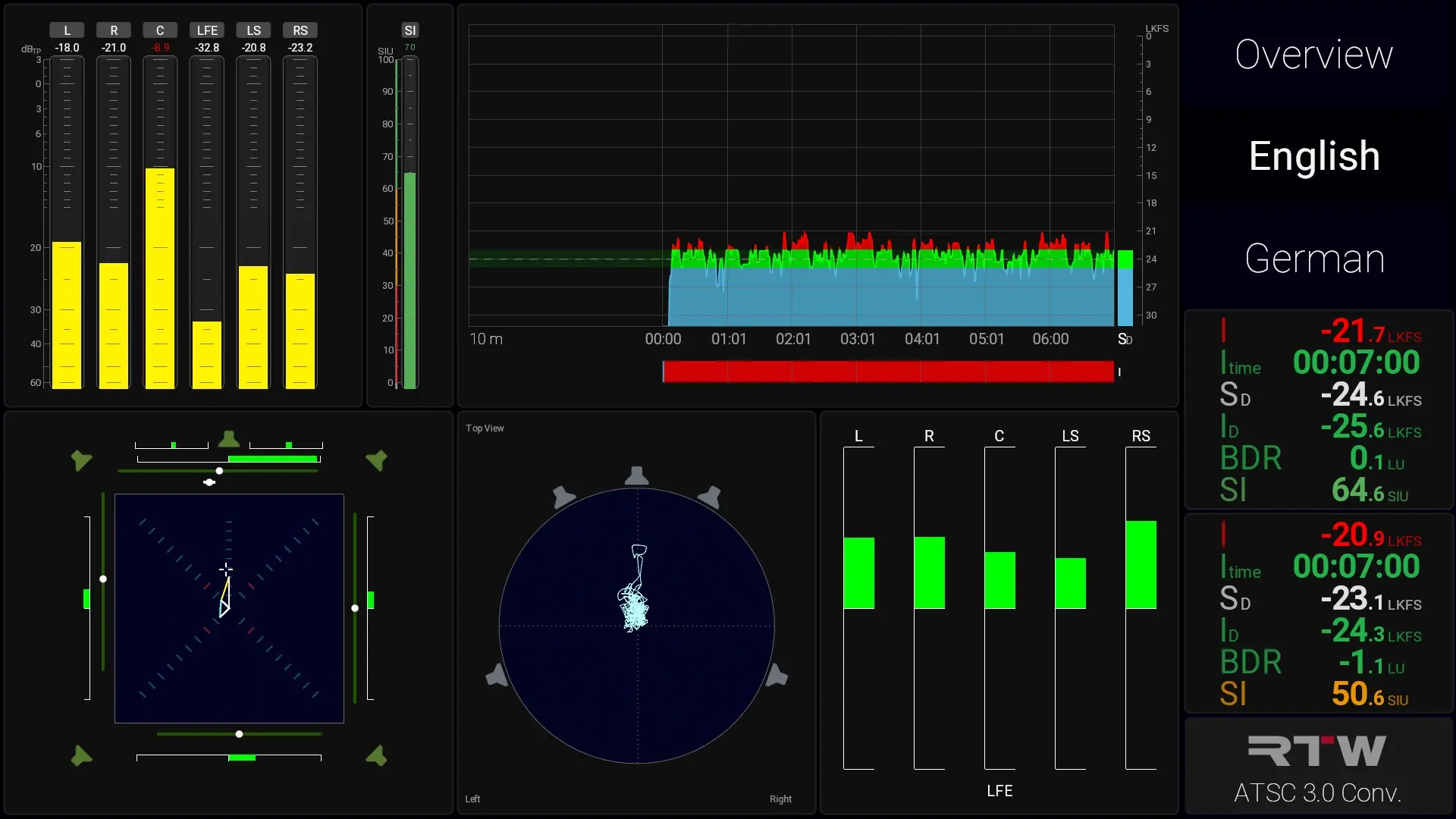
The Presentation approach
The presentation-based approach is a newer method in which audio is transmitted as substreams of individual components, with the final mix rendered at the decoder stage after transmission, typically on the end-user device, such as a TV or soundbar.
The main idea is to avoid transmitting the same audio channels (e.g., surround audio) multiple times. Instead, individual elements are delivered separately as selectable content. This content may include different language versions, audio description channels, or alternative commentary, for example, multiple commentators for a sports event.
From a technical perspective, this approach enables higher audio quality, as the required bitrate is significantly lower. In the example above, the presentation-based approach requires only 8 channels, whereas the conventional approach requires at least 12.
For the end user, this also enables local control of the balance between dialog and background (music and effects), using features such as Dialog Enhancement (DE) and Dynamic Range Control (DRC).
For the mixing engineer, this requires analyzing individual streams separately and verifying potential issues in the final mix at the decoder stage.
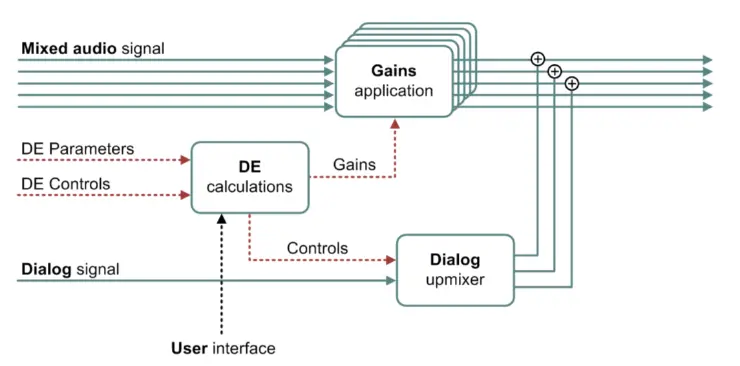 Dialog Enhancement block from AC-4 Standard ⁴⁾
We have made an example preset for a 5.1 program with two languages and an additional audio description (AD) channel. It includes four metering applications:
- Music and effects: 5.1 with ITU loudness (ATSC/85, no anchor)
- English language: Mono Dialog Gated loudness (ATSC/85) with Dialog Intelligibility meter
- German language: Mono Dialog Gated loudness (ATSC/85) with Dialog Intelligibility meter
- AD language: Mono Dialog Gated loudness (ATSC/85) with Dialog Intelligibility meter
Download it here:
Here is how it works.
Overview
The Overview displays the current status of each audio stream, along with a Ratio instrument for each dialog stream. This instrument shows the ratio between the short-term dialog loudness and the short-term loudness of the Music & Effects (M&E) stream.
The Ratio meter helps ensure that dialog (when present) is not masked by the M&E content. Depending on the program type, the desired ratio typically ranges from 0 to 20 dB.
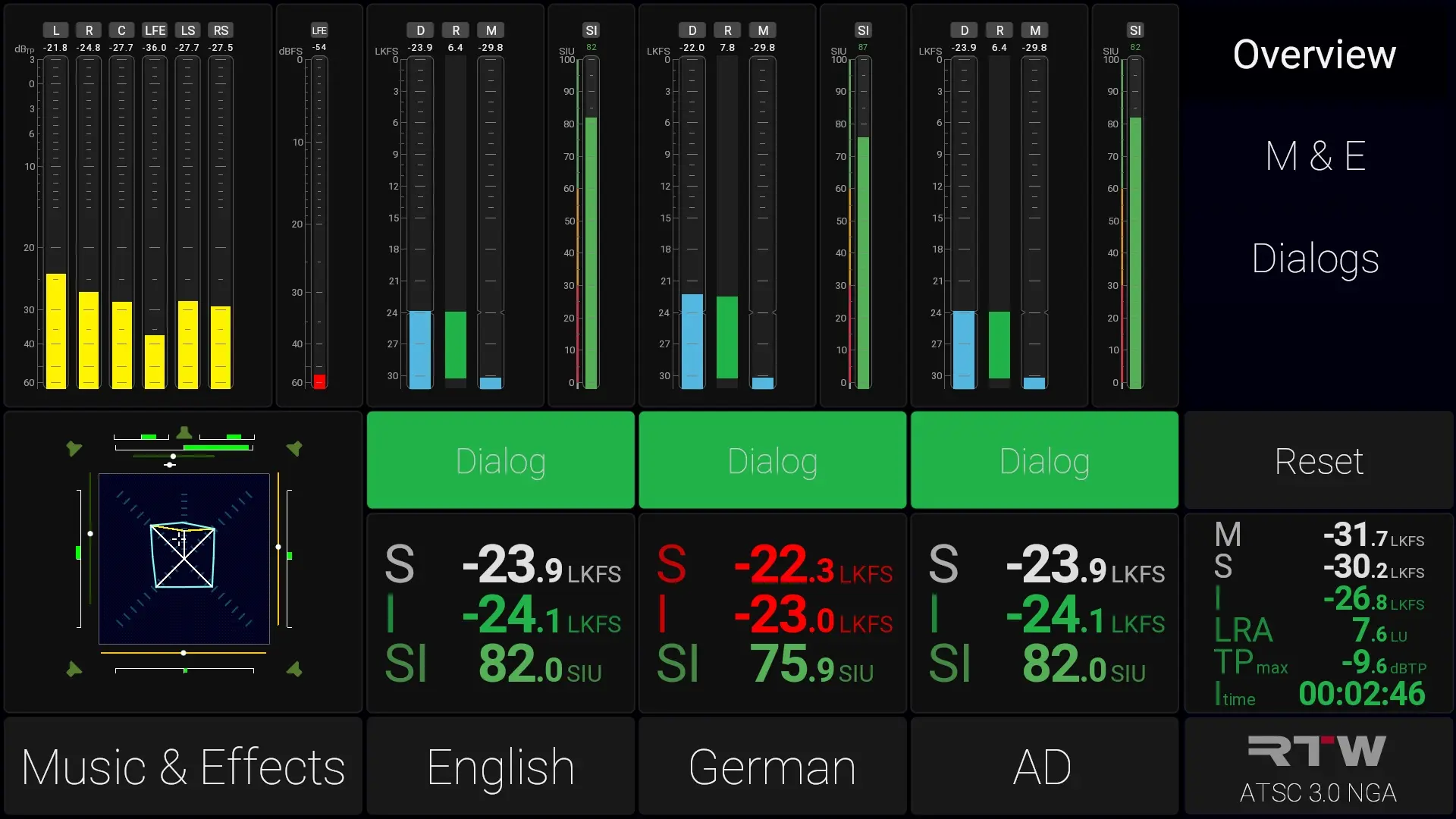
M & E
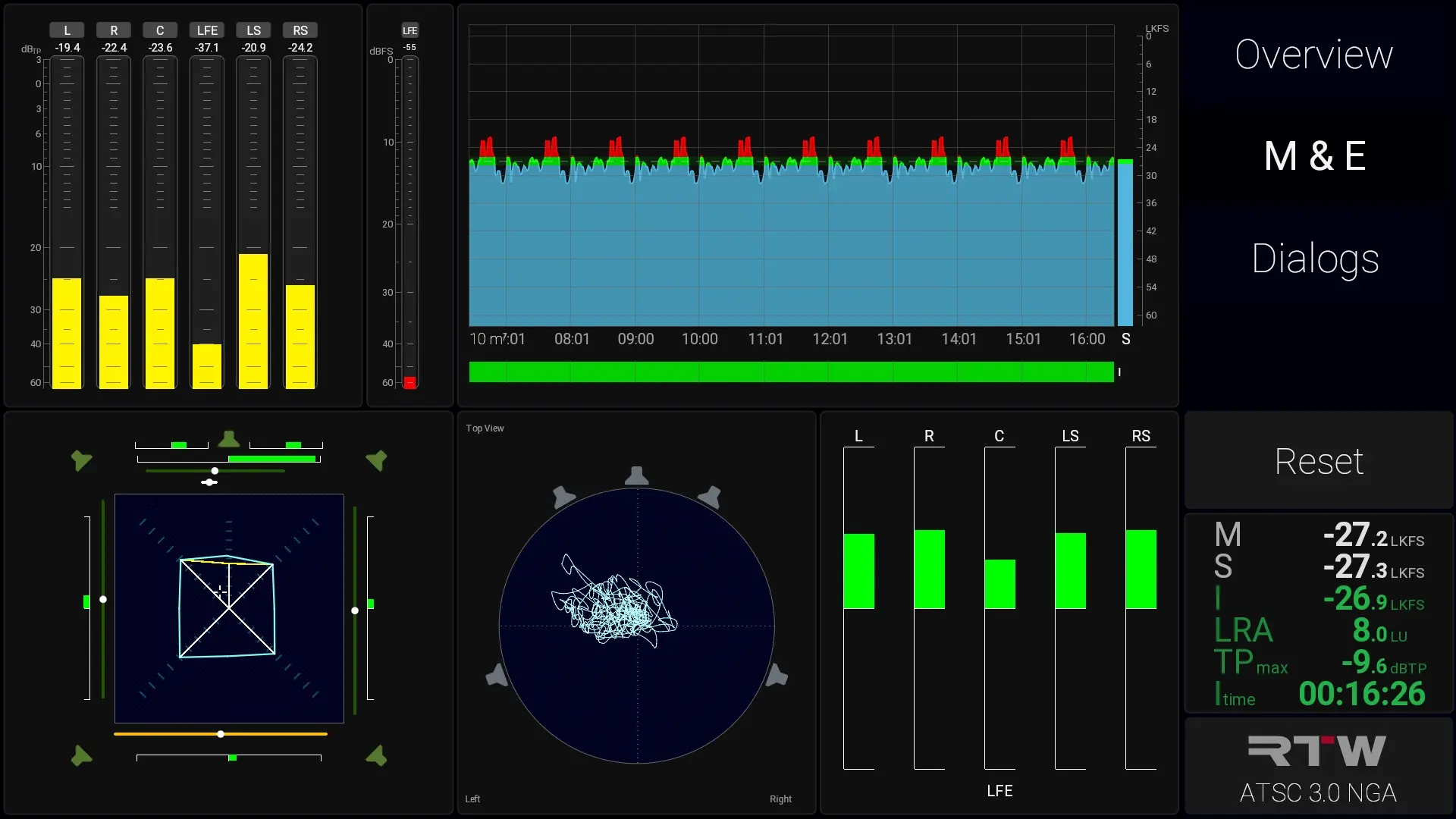
The second view allows the user to analyze the main M&E stream using PPM meters, a short-term and integrated loudness chart, a Surround Sound Analyzer, a Polarscope, an LFE Correlator, and LFE bleed.
Dialogs
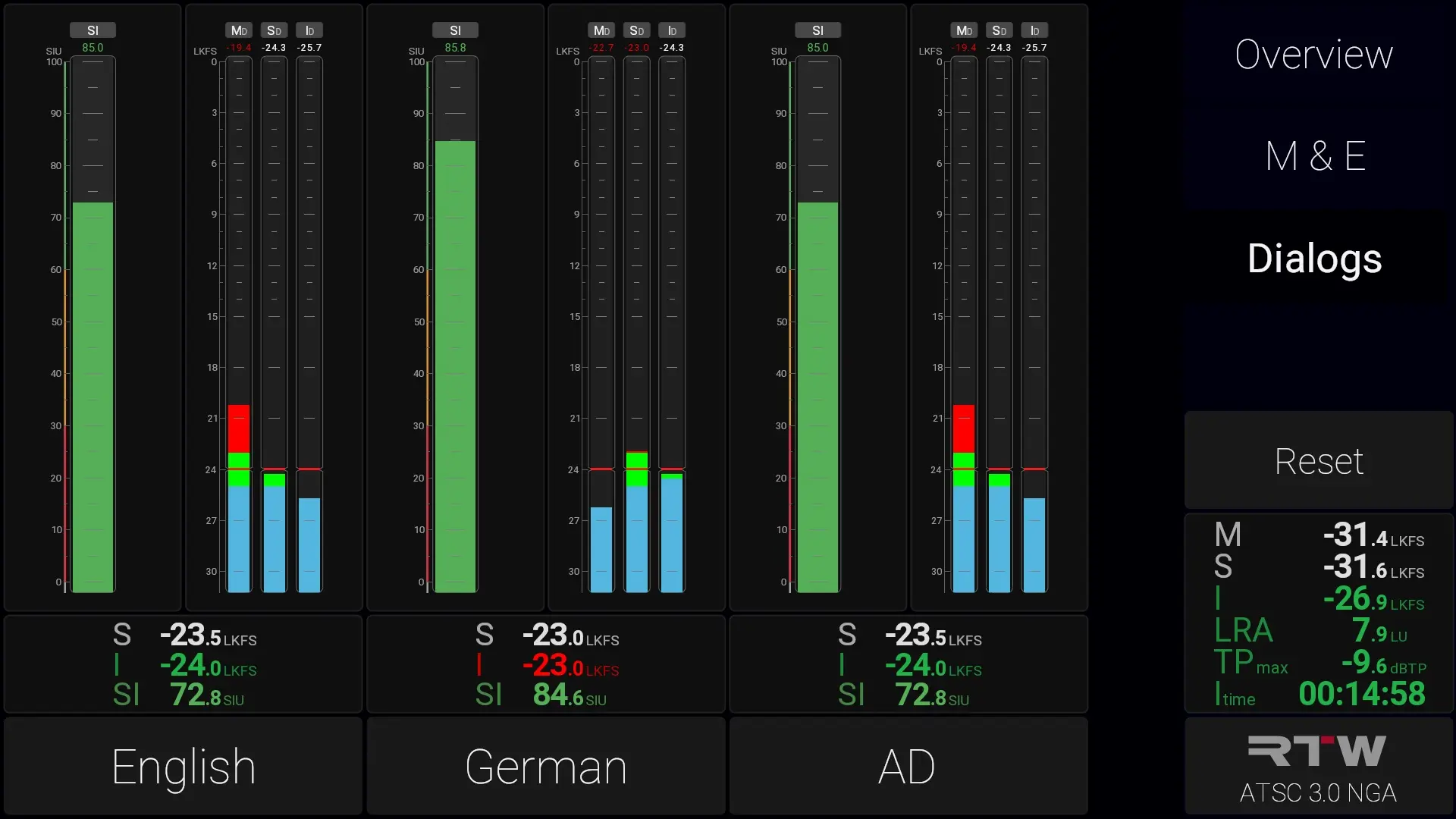
The third view provides a detailed analysis of dialog-based loudness and intelligibility for each dialog channel. Note that, in this case, dialog intelligibility is measured pre-mix, helping to identify potential intelligibility issues at an early stage.
Key Takeaways
In ATSC 3.0 workflows, measuring multilanguage audio requires a shift from traditional channel-based monitoring to a more flexible, component-based approach. While the conventional method remains straightforward, monitoring complete mixes per language, the presentation-based approach introduces new efficiencies by transmitting individual elements and rendering the final mix at the decoder stage.
This evolution reduces bandwidth requirements and enables greater flexibility for end users, including personalized control over dialog and background balance through features such as Dialog Enhancement (DE) and Dynamic Range Control (DRC). However, it also places new demands on the mixing engineer, who must ensure that each component stream performs correctly both individually and in combination.
By analyzing dialog, music, and effects separately, and verifying their interaction in the final mix, engineers can maintain intelligibility, balance, and compliance across all delivery scenarios.
Carefully designed TMxCore presets support this process, providing the necessary tools to monitor loudness, dialog intelligibility, and inter-stream relationships throughout the production chain.
References:
- ATSC 3.0 Standards, Advanced Television Systems Committee, 17 July 2025
- Dolby® AC-4: Audio delivery for next-generation entertainment services, Dolby © 2021
- ATSC/85, Advanced Television Systems Committee, 12 March 2013 (PDF)
- Digital Audio Compression (AC-4) Standard, EBU, April 2014 (PDF)