Thomas Valter • Director of Product Management, RTW
March 14, 2026
Starting with technologies introduced by Dolby® many years ago, there have been numerous attempts to quantify dialog intelligibility using various loudness-based measurement techniques, and various approaches are still under evaluation.
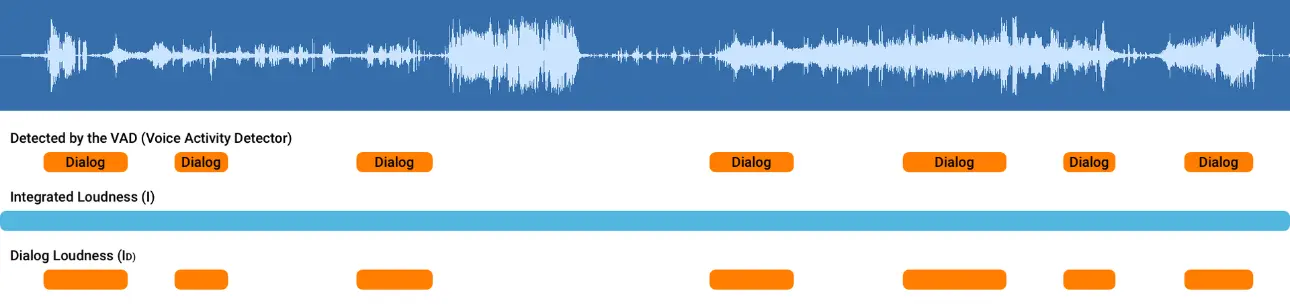
Dialog Gated Loudness
Dolby® has been working with dialog-focused audio processing for decades.
The core idea was to use dialog as the anchor point for loudness normalization, thereby having more focus on dialog than on other things.
Instead of normalizing the entire programme based on overall loudness, Dolby’s approach normalizes the audio using only the dialog segments.
The rationale is simple: by anchoring to dialog, you naturally place greater emphasis on it - ensuring that it remains intelligible and prioritized within the mix.
Dolby Dialogue Intelligence™ is used as a delivery standard by various media, including Netflix.
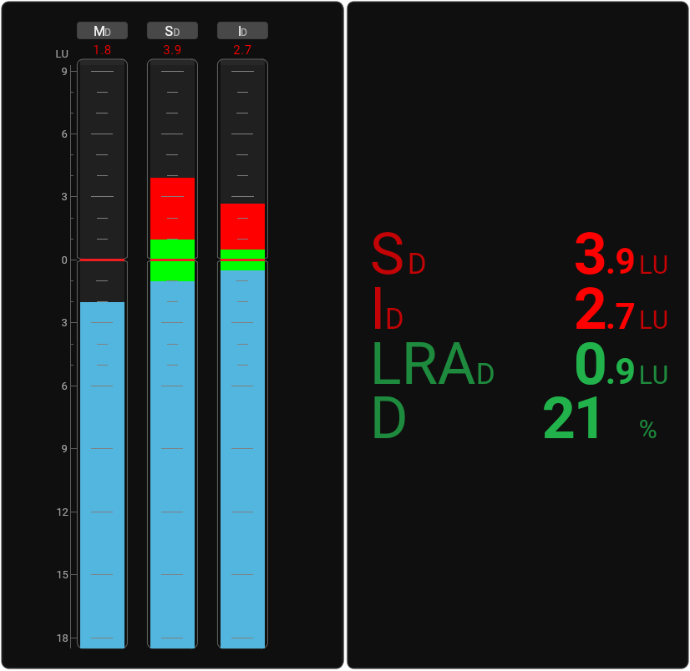
Dialog-gated loudness measurement is available in the TouchMonitor 5, TouchControl 5, and TMxCore.
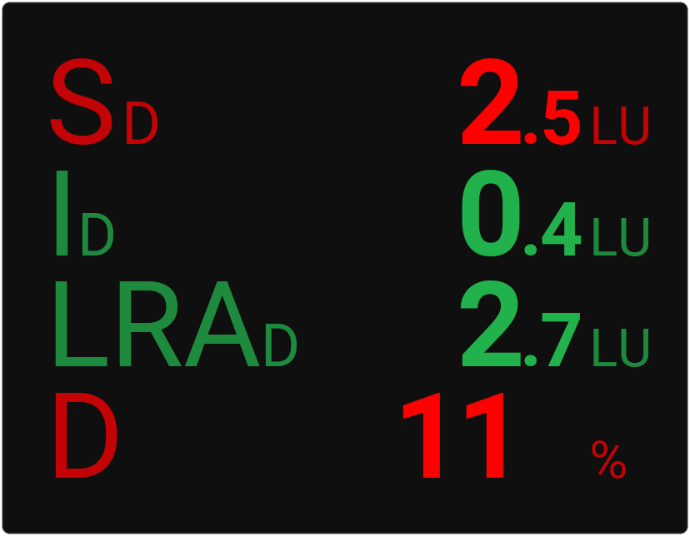
There a several ways to show the measurements, including bar graphs, numerics and chart. The following measurement parameters are provided.
MD
Momentary loudness, dialog gated, LU
This measurement corresponds to momentary loudness (400ms window), but it is only active during segments where dialog is detected.
SD
Short-term loudness, dialog gated, LU
This measurement corresponds to short-term (3 second window) loudness, but it is only active during segments where dialog is detected.
ID
Integrated loudness, dialog gated, LU
This measurement corresponds to integrated loudness (length of entire program), but includes segments only where dialog is detected.
Under normal circumstances, the ID is lower than I, typically by approximately 4 LU, of course depending on content.
If the program consists of only dialog and no segments with no dialog, ID = I.
LRAD
Loudness Range, dialog gated, LU
This measurement corresponds to Loudness Range, but includes segments only where dialog is detected.
D
Dialog amount, %
This is the amount of dialog segments measure in the program.
In order for dialog gates measurement to make sense, a certain percentage of the program needs to include dialog.
In an RTW meter, this setting is user definable,
Background-to-Dialog Ratio
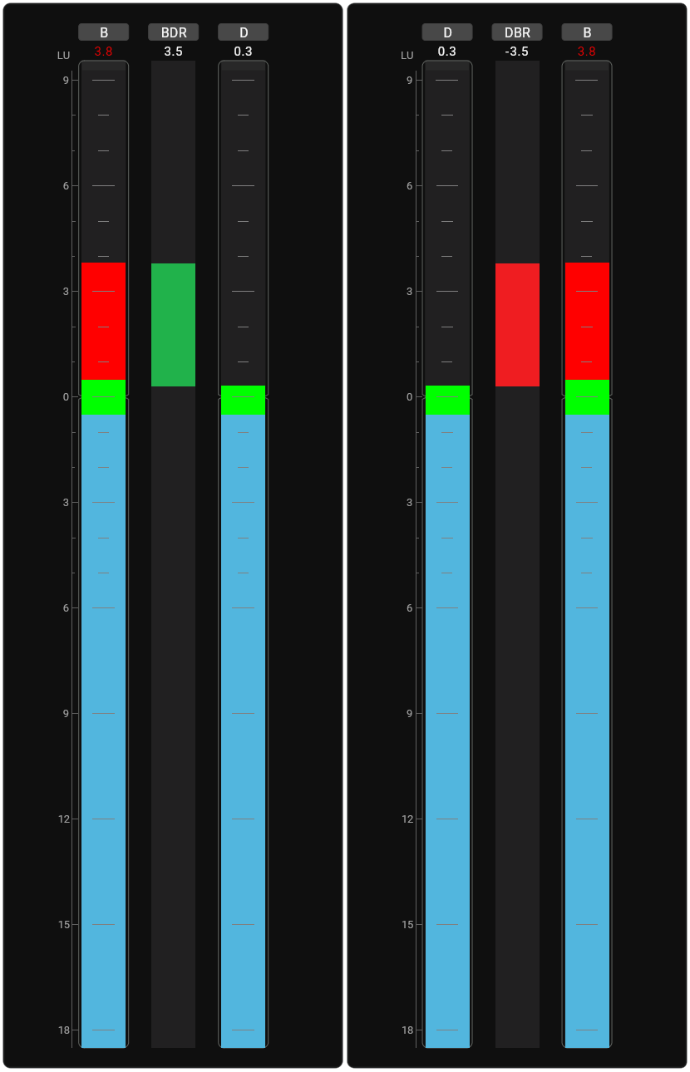
Another method of quantifying dialog intelligibility is by defining a minimum ratio between the dialog and background audio: Background-to-Dialog Ratio - or simply BDR.
This measurement is based on integrated loudness by default, but can also be set to use short-term loudness for realtime metering.
In essence, this indicates how much the background environment masks the dialog. The higher the noise level, the lower the dialog intelligibility.
This can also be described as a dialog-to-noise ratio, or a signal-to-noise ratio where the signal represents the dialog.
In surround formats, dialog is typically placed in the front channels (L-C-R), while background elements are spread across the remaining channels. This opens the door for a relatively straightforward approach:
- Detect dialog presence in the front channels and measure its loudness.
- Measure the loudness of the segments with no dialog - background.
- Calculate the ratio between dialog and background.
Importantly, dialog is only calculated when dialog is detected. If no dialog is present, the measurement is classified as background.
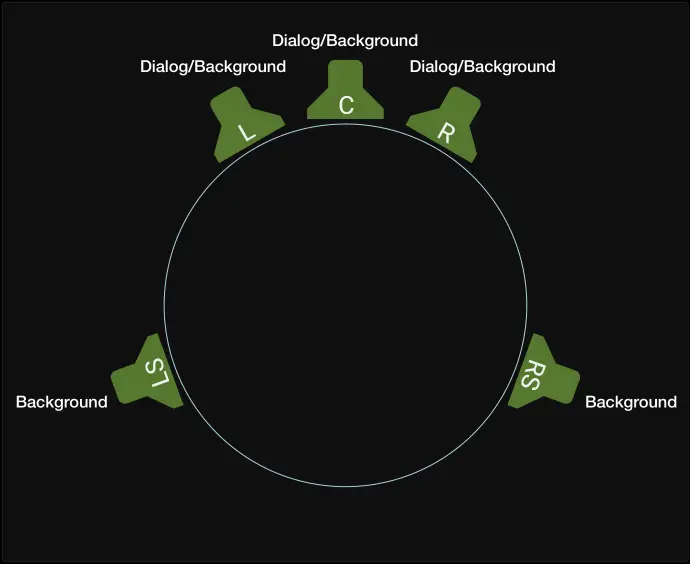
Channel format.
BDR is most meaningful with channel formats where dialog and background are present on separate channels.
This typically applies to surround and immersive formats.
In contrast, BDR is less relevant for stereo or mono signals, where dialog and background are combined within the same channels.
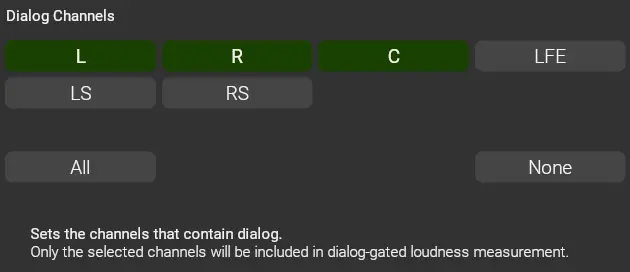
With RTW instruments, you can specify which channels may contain dialog.
The BDR-measurement is available in the TouchMonitor 5, TouchControl 5 and TMxCore.
There a several ways to show the measurements, including bar graphs, numerics and chart. The following measurement parameters are provided.
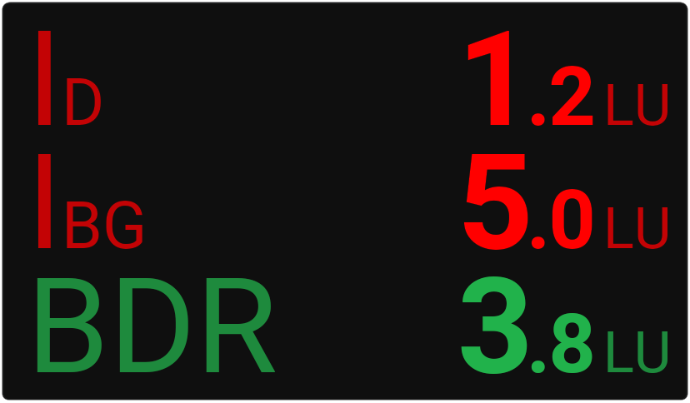
ID
Integrated loudness, dialog gated, LU
This measurement corresponds to integrated loudness (length of entire program), but includes segments only where dialog is detected.
IBG
Integrated loudness, dialog gated, Background Channels, LU
This is a measurement of the integrated loudness in sections classified as background: Channels that do not contain dialog, or channels where dialog is not present.
BDR
Background-to-Dialog, LU
This is the ratio, in LU, between the dialog segments (s) and the background segments.
DBR
Dialog-to-Background, LU
Same as BDR, but value is negative compared to BDR.
Loudness Dialog Summation
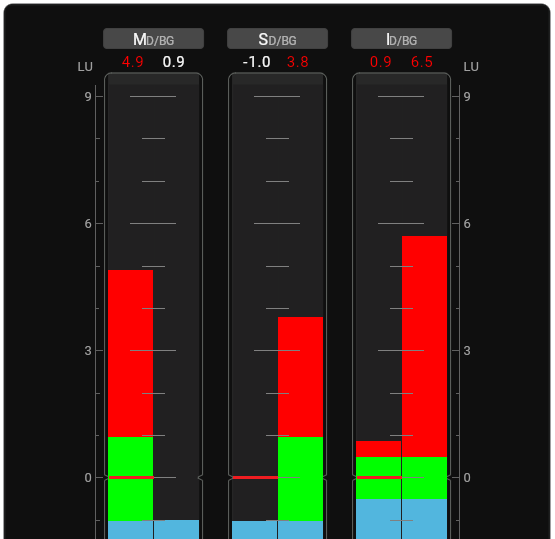
With the Loudness Dialog Summation instrument, you can also choose to display the background channels, so for each measurement bar M, S and I, you also see the BG.
Loudness-to-Dialog Ratio
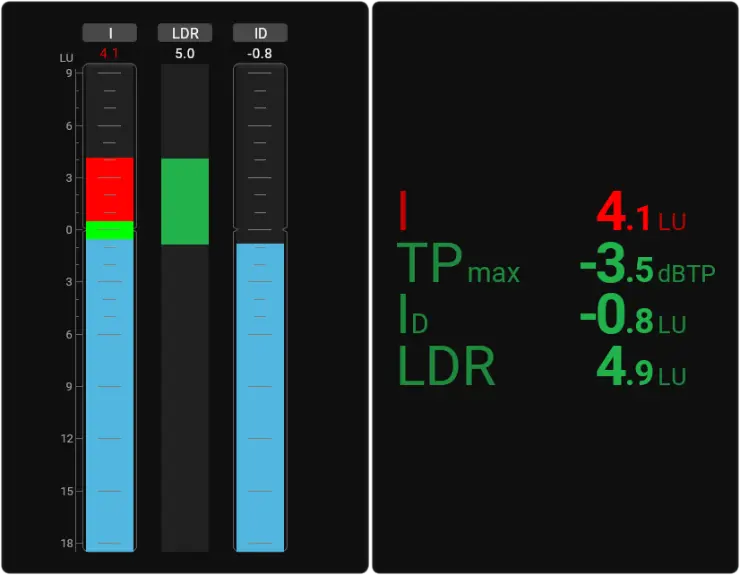
The concept is simple: once dialog has been identified and its loudness measured, the LDR is calculated as the ratio between the dialog loudness and the integrated loudness.
Since integrated loudness includes all sections - including those with dialog - the lower the LDR value, the "better".
An LDR value of 0 indicates that the entire program contains dialog.
EBU Recommendation
LDR is the method currently recommended by the EBU, in R128 Supplement 4.
Be aware that the EBU document addresses Cinematic Content for broadcast.
According to EBU recommendation, the LDR should not exceed 5 LU - meaning the overall programme loudness (I) must be no more than 5 LU louder than the dialog loudness (ID).
the Loudness-to-Dialogue Ratio of Cinematic Content should not exceed 5 LU.
The EBU recommendation also specifies a true-peak maximum value of −1 dBTP. For this reason, the TPmax value is included in the numeric display as well.